OTY cyclones
Cyclones have been developed to rationalize the working conditions of employees and to maintain the ecological situation at industrial enterprises in accordance with the requirements of sanitary standards. Cyclones of the OTY class are designed for catching mixed dry grain waste in pneumatic transport systems at food and grain processing enterprises. These units are not suitable for work with a fibrous structure, with dust characterized by a tendency to stick together.
OTY class cyclone marking:
Example of designation of cyclone "OTY - 700", where:
- "THIS" - development of the Odessa Technological Institute;
- "700" - inner diameter of the cylindrical section, mm.
Constructive advantages
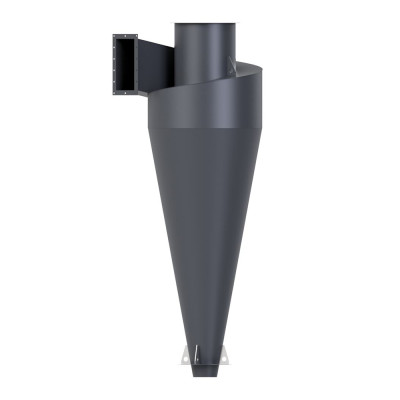
OTY class cyclones have parts:
- body;
- connecting/exhaust pipe (pipe);
- hopper for collecting dust.
Cyclones of this class are made of carbon, low-alloy steel, can be made in an explosion-proof version (explosion valves, bunker with minimum dimensions). Bunker – the accumulator is an important component of the cyclone. The storage period of captured waste in the bunker is determined by its dimensions. It is necessary to carry out regular extraction of waste from the bunker capacity, usually this process is carried out once per shift or per day.
Productivity in OTY class cyclone models varies from 500 to 5200 m3/h, the diameter of the cylindrical part - from 300 to 1000 millimeters, height – 930 ÷ 3100 millimeters, mass – 15 ÷ 155 kg. The optimum speed of entry of the clogged flow for these cyclones is 10-14 m/c. The efficiency of cleaning contaminated air with OTI cyclones reaches 97% - 98%.
Principle of work
The principle of operation of the simplest counterflow cyclone: the flow of clogged air is fed by means of a fan through the inlet pipe into the upper part of the cyclone at a fairly high speed. Due to the shape of the cyclone cylinder, a rotating flow of clogged air is formed, which is directed to the lower part of the unit. Under the action of centrifugal force, dust particles fly to the walls, are captured by the air flow, are transferred down into the conical part, and then through the discharge hole they fall into the hopper - collector. Freed from mechanical impurities, the air flow changes by 180° the direction of movement moves from the bottom to the top, exits the unit into the exhaust pipe.
Advantages
The main advantage of OTI class cyclones is resistance to velocity fluctuations at the entrance to ± 35%, which is especially important for systems operating with variable mode. They are simple and reliable.
Scope of application
OTY cyclones are used at grain processing plants and food enterprises in pneumatic transport systems, aspiration of grain cleaning separate mills.
Features of operation
OTY class cyclones are in demand, as a rule, for group installation – two ÷ eight aggregates for a significant increase in the coefficient of capture of foreign particles. It is the group application of air cleaners of the OTY class that guarantees high efficiency of cleaning air flows in industrial conditions.