


Modern buildings with active flows of people or vehicles require solutions that combine comfort, energy efficiency, and operational convenience. This is especially relevant for entrance areas, where the impact of external conditions is felt most strongly. In such locations, it is important not only to maintain a stable temperature but also to control air exchange without restricting movement. Thermal air curtains make it possible to create a controlled temperature boundary without changing the functional logic of the entrance.

Where Thermal Air Curtains Are Used and What They Are
A thermal air curtain is a climate control device from the thermal ventilation category, designed to create a directed airflow in passage zones between environments with different temperatures. Its main purpose is not direct heating, but reducing air exchange between outdoor and indoor spaces. This lowers the load on heating, air conditioning, and ventilation systems. Such a solution is especially effective in facilities with frequently opened entrances, where traditional heat retention methods do not provide the desired result.Creating a Thermal Barrier
During operation, the air curtain forms a dense airflow that blocks the opening zone. This dynamic barrier limits the mixing of air with different temperatures. With the correct direction and speed, the airflow retains heat inside and restrains incoming external air. Even with frequent door openings, this protection maintains a stable microclimate without creating mechanical obstacles to movement. Air in the entrance area stops circulating chaotically and behaves predictably. There is no sensation of sharp cold near the doors, even under heavy traffic conditions. The space remains thermally uniform, without cold spots near the entrance.
Protection Against Cold and Heat
The operation of the curtain is aimed at preventing cold air penetration during winter and limiting the inflow of hot air in summer. When doors are opened, outdoor air does not enter the building uncontrollably, as the curtain airflow acts as a protective screen. As a result, the device maintains a comfortable indoor temperature without sharp fluctuations or drafts. Even strong gusts of wind from outside do not disrupt the internal balance.
Maintaining Indoor Climate Stability
Indoor climate stability is achieved through controlled airflow movement in the entrance zone. Indoor air does not escape outside with every door opening, allowing predefined climate parameters to be maintained. This is especially important for retail spaces, public buildings, and areas with increased temperature control requirements. The climate does not break down into separate zones but remains evenly distributed throughout the entire area. It becomes easier to maintain comfort inside the building without constant system adjustments.
How the Air Barrier Works: Operating Principle of a Thermal Air Curtain
In engineering practice, the operating principle of a thermal air curtain is based not on heating the space, but on controlling air movement. When switched on, the device forms a dense, directed airflow that runs along the entrance zone and effectively separates the indoor and outdoor environments. This air boundary operates continuously, even when the passage is open, and does not interfere with the movement of people or equipment.Warm Airflow as a “Wall”
Inside the device, a fan generates a stable airflow that exits as a uniform jet. If necessary, the air passes through a heating element, forming a dense vertical or horizontal curtain of warm air. This air barrier restrains cold air masses and minimizes heat losses in the passage area.
Airflow speed plays a crucial role in the device’s operation, as it determines the jet’s ability to maintain integrity along the full height of the opening. A weak airflow dissipates quickly, while a properly adjusted one retains its shape even under pressure differences. This allows a stable thermal balance to be maintained without increasing the load on other systems.
Vertical and Horizontal Installation Schemes
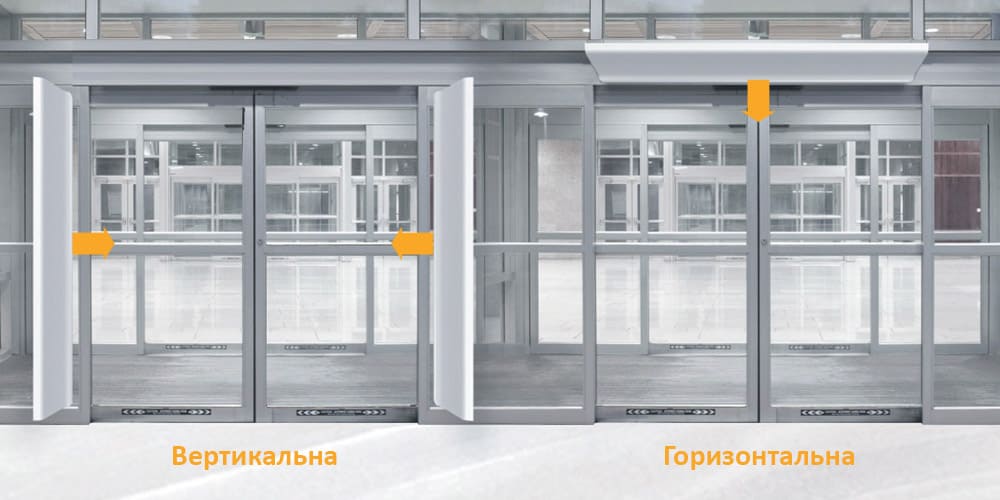
There are horizontal and vertical equipment placement options. Horizontal installation is performed above the passage and is suitable for standard entrances. For wide openings, the curtain is installed vertically on the sides, allowing the entire opening height to be covered. Additionally, when installing air curtains, the following are considered:
- ceiling height;
- lighting layout;
- availability of power supply or heat carrier connections.
For openings with intensive vehicle traffic, side installation is often chosen, as it ensures uniform air distribution along the entire passage. In compact entrance openings, top installation is preferred because it is less visible, does not interfere, and does not alter spatial perception.
Types of Thermal Air Curtains
There is a clear classification of thermal air curtains that allows equipment selection according to building architecture, traffic intensity, and climate requirements. Different types of thermal air curtains differ by:- heating method;
- design;
- installation orientation;
- application area.
Electric and Water-Based
Thermal air curtains are divided into electric and water-based types. Electric curtains operate from the power grid and are equipped with built-in air heating elements, making them autonomous and easy to connect. Water-based thermal air curtains, on the other hand, are integrated into a heat carrier system and use centralized heating energy, which is especially beneficial for large facilities. Water curtains reduce electrical load and are well suited for buildings with developed engineering infrastructure. The choice between these solutions depends on available resources, operating mode, energy efficiency requirements, and installation specifics.
Industrial and Domestic
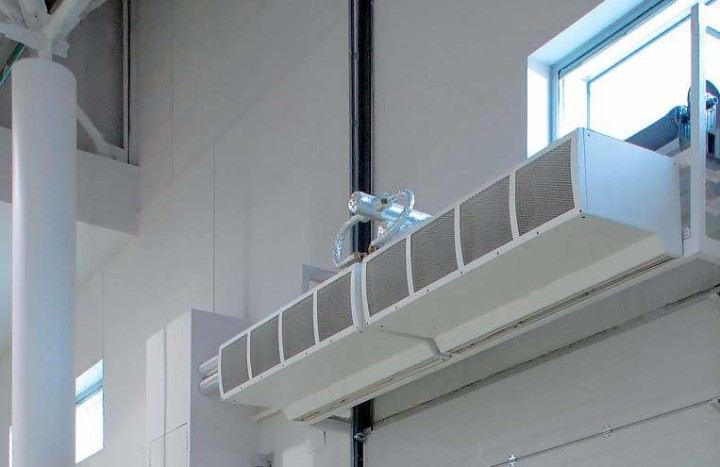
By application area, air curtain models are divided into industrial systems and compact solutions for civil spaces. Industrial systems are actively used in logistics centers and warehouses, where the ability to cover wide openings and operate continuously is essential. Such units are designed for higher power and performance. Domestic options are used in shops, offices, and service areas, where compact size, neat appearance, and moderate power are key factors. Both categories perform the same function but are adapted to different operational scales.
Ceiling, Wall-Mounted, and Built-In
By installation configuration, air curtains are divided into solutions mounted above, on the side, or directly within the opening structure. Ceiling-mounted formats are used when there is sufficient space above the entrance. Wall-mounted solutions are applied where openings are wide or geometrically complex. Built-in models are installed directly into the doorway, preserving interior integrity. In all cases, stable airflow is the decisive factor that determines operational reliability and effective environment separation.
Where Thermal Air Curtains Should Be Installed
The use of thermal solutions is most justified in areas with constant or cyclic traffic through doors or gates, where temperature differences quickly affect the indoor microclimate. Such facilities include retail halls, public buildings, production areas, and logistics centers. Air curtains also effectively limit the penetration of dust, odors, and insects. Depending on the building’s engineering infrastructure, various air curtain systems are applied, including water-based thermal air curtain solutions.Thermal Air Curtain vs Heater: What Is the Difference
The fundamental difference lies in the method of microclimate impact. A heater raises the air temperature throughout the entire room volume, while a thermal air curtain works locally, covering the doorway. It creates a controlled barrier that reduces heat loss and improves heating efficiency without increasing the power of primary heating devices.How to Choose a Thermal Air Curtain Correctly: 5 Key Criteria
Proper equipment selection begins with analyzing operating conditions. Before purchasing, it is important to consider:
- Entrance width and height.
- Airflow performance.
- Required heating level.
- Installation type.
- Compatibility with existing systems.
Advantages of TZE Thermal Air Curtains
- reduced heat loss;
- stable indoor microclimate;
- reduced load on heating and air conditioning systems.
We invite you to select a suitable thermal air curtain model via https://ventilator.ua/en/category/tze-air-curtains/.
Write a comment